
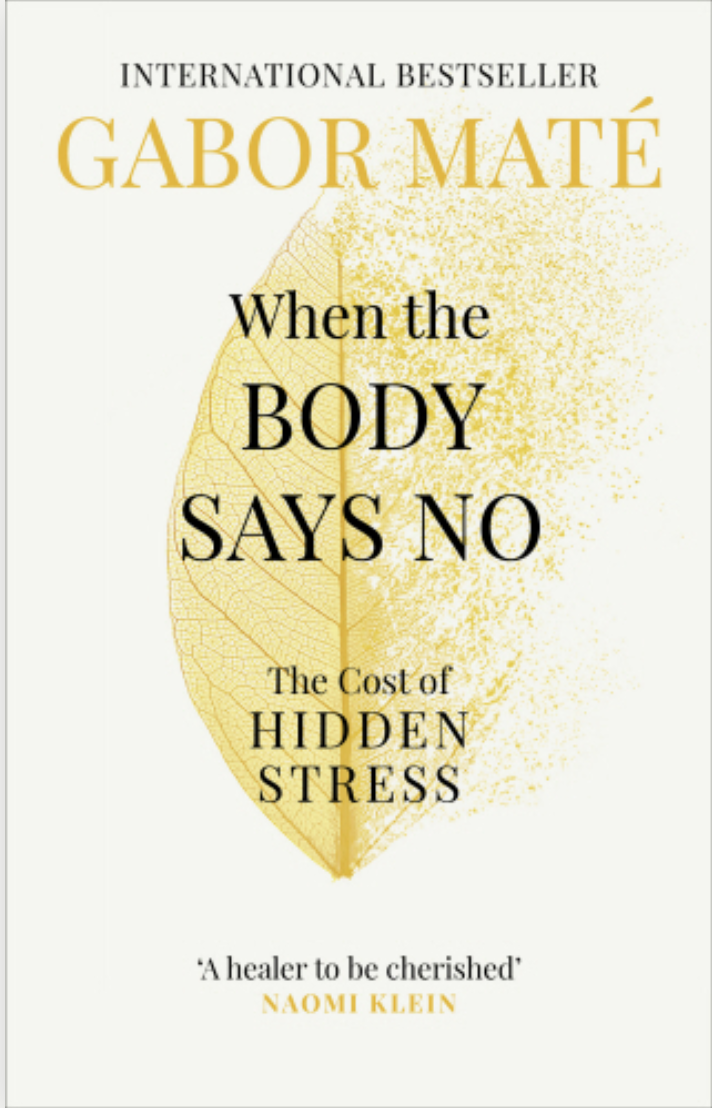
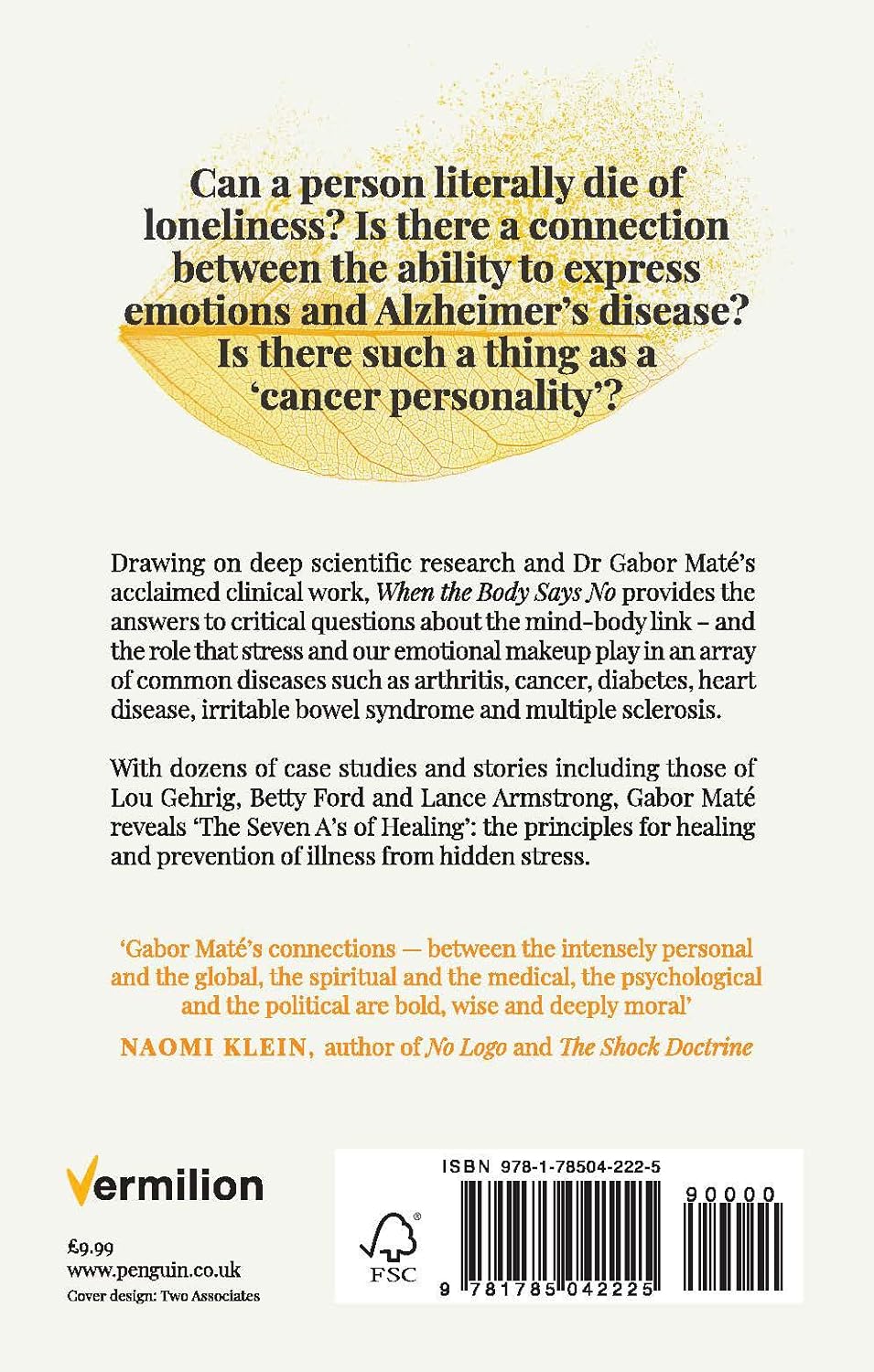
Reading this book was like being handed a mirror — not to judge myself, but to finally understand. Dr. Gabor Maté compassionately unpacks how our lifelong habits of emotional suppression, people-pleasing, and self-denial — often born in childhood — can quietly manifest as illness. This isn’t about blame, but about reclaiming awareness: that our bodies remember what our minds try to forget.
Maté redefines trauma not as what happened to us, but what didn’t happen — the emotional attunement, protection, or freedom to be our authentic selves. In those early moments of unmet need, we learn to adapt, to perform, to please… but at the cost of our true self. Over time, that disconnection can turn into physical symptoms — autoimmune conditions, cancer, chronic fatigue, and other diseases that speak the language we’ve long suppressed.
What struck me most deeply was how compassionately he connects illness with unacknowledged emotional pain — not to say we caused it, but to show us where we may begin to listen, to feel, and to heal. And he doesn’t leave us in the discomfort of that truth — he offers hope in the form of the Seven A’s of Healing, a soulful, empowering framework that gently calls us back to ourselves.
These seven principles — Acceptance, Awareness, Anger (as boundary), Autonomy, Attachment, Assertion, and Affirmation — became, for me, like signposts on the healing path. Each one reminded me that wholeness isn’t about becoming someone new — it’s about remembering who we were before we had to disconnect.
Dr. Maté’s wisdom helped me see that healing isn’t a race or a fix — it’s a deep listening. To the body. To the stories we’ve silenced. To the child inside who once felt unseen. And through this compassionate gaze, the body’s “no” can become a gateway to a fuller, truer “yes.”
Key Takeaways
- Emotional repression has a physical cost.
Suppressing emotions like anger, sadness, or even joy often stems from childhood survival patterns — but our bodies eventually carry the weight.
→ This ties to Awareness and Anger: becoming conscious of our emotional truth and allowing ourselves to feel it without shame. - The mind and body are not separate.
Modern medicine often separates physical and emotional health, but Maté shows they are deeply interconnected.
→ Healing begins with Acceptance: welcoming our inner experiences with compassion rather than resistance. - Patterns begin in childhood.
Roles like the pleaser, achiever, or caretaker often begin as protective strategies. But over time, they can disconnect us from our true selves.
→ Cultivating Autonomy helps us step out of those roles and choose who we are today. - Saying no is essential.
Learning to say no isn’t selfish — it’s a way of saying yes to our health and well-being.
→ This requires Assertion: owning and expressing our needs with clarity and courage. - Compassion is key.
Maté’s work is steeped in gentleness. It’s not about blaming ourselves or others, but about understanding and softening toward our own wounds.
→ This is where Affirmation plays a role — validating our experiences and reminding ourselves that we are enough. - We don’t heal alone.
Safe, loving connection is vital for healing. Whether with a trusted friend, therapist, or community, we need spaces where our stories can be heard.
→ This speaks to the power of Attachment: our innate need for secure, nurturing relationships. - Healing is not about fixing — it’s about returning.
The Seven A’s are not rules, but reflections — helping us come home to ourselves, one layer at a time.
→ Together, they offer a map back to wholeness, reminding us that our bodies are not betraying us — they are trying to tell the truth.
The “Seven A’s of Healing” that Dr. Gabor Maté outlines are among the most tender and transformative aspects of the book and have had a huge impact on my own personal life. They’re not a step-by-step solution, but a compassionate invitation to reconnect with yourself — not just to heal illness, but to begin living more authentically, aligned with your truth.
1. Acceptance
Rather than fighting or denying our past or present, Maté encourages us to meet it with acceptance — not resignation, but recognition. Accepting that we’ve adapted in certain ways for survival opens space for compassion and growth.
Personal insight: This taught me that change doesn’t come from shame. Only when I stopped fighting with myself could I begin listening to what needed care.
2. Awareness
Healing begins with noticing. Many of us move through life disconnected from our emotional truth. Maté invites us to gently become aware of our stress patterns, emotional triggers, and physical symptoms — not as problems to fix, but as signals pointing us inward.
Application: I’ve started checking in with myself and when necessary, with my partner, when I feel tension or overwhelm. “What’s really going on inside?” It’s a small question that opens big doors.
3. Anger
Anger is not aggression. It’s a boundary — a healthy, natural emotion that signals when our needs or limits have been crossed. Many of us have suppressed anger to keep the peace, but doing so can lead to internalised stress and illness.
What I learned: My suppressed anger was showing up in fatigue, resentment, even physical pain. Learning to honour it — respectfully — has been freeing.
4. Autonomy
Chronic stress often arises when we feel we can’t be ourselves — when we’re constantly shaped by the needs or expectations of others. Autonomy is the freedom to act in alignment with our truth. It’s about saying no when we need to.
Reflection: For me, this meant realising that it’s okay to say no without guilt — and that no can be a full sentence.
5. Attachment
Healthy relationships are a foundation for healing. Maté reminds us that safe, nourishing connections — especially those where we feel seen without having to perform — are essential. We’re wired for belonging, not perfection.
What shifted: I began to understand that isolation wasn’t strength — it was self-protection. Reaching out, softening, trusting — this is where healing lives.
6. Assertion
Healing requires a voice. Assertion is not about being forceful, but about expressing who we are — our needs, limits, and truths — with clarity and courage. Many chronic conditions are linked to the long-term habit of self-silencing.
Insight: I used to think being quiet made me “good.” Now I know that using my voice is part of healing my nervous system, and my story.
7. Affirmation
Lastly, we need to affirm our worth. This is about more than self-esteem — it’s about recognising the inherent value we’ve always had, even when it was overlooked or dismissed. We heal by remembering we are enough, as we are.
Reminder I hold close: I don’t have to earn love, rest, or joy. I am already enough. And so are you.
The Seven A’s of Healing aren’t rules or prescriptions — they’re gentle invitations to come back home to ourselves. For me, they’ve been a quiet but steady guide toward wholeness — a compass that reminds me that healing is possible not by becoming someone new, but by remembering who I was before I learned to disconnect.
Each “A” has helped me unlearn something painful and relearn something powerful — how to trust myself, to honour my emotions, and to stop abandoning the parts of me that needed love the most.
If there’s a takeaway I’d love for others to carry: healing doesn’t demand perfection — only presence. Just one small act of self-acceptance, one honest “no,” one brave conversation, can open the door to change.
0 comments